
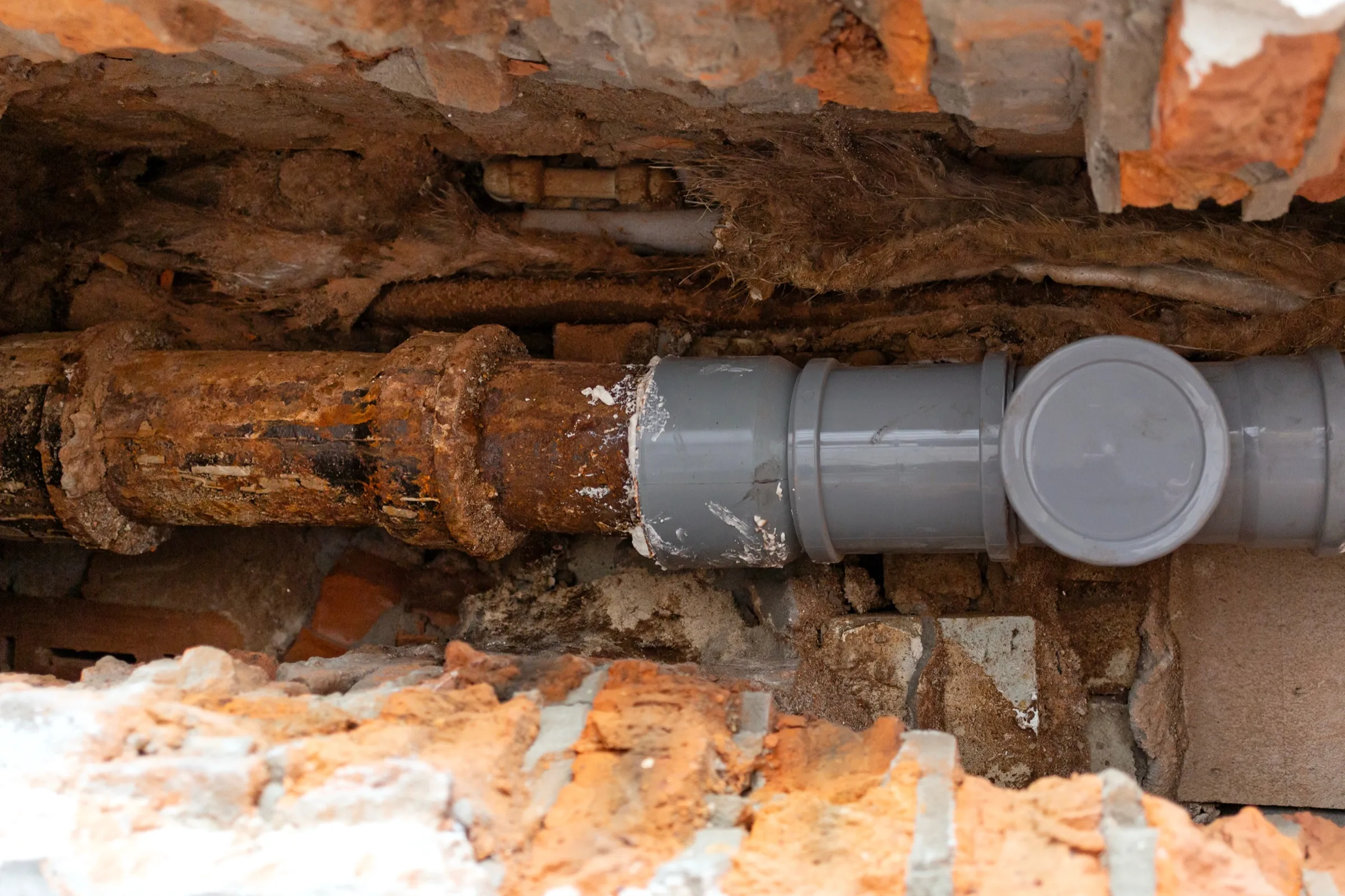
Some houses tell you their age through the plumbing. This one — a well-kept ranch in an established Sachse neighborhood — was doing it through the drains: another backup every few months, another cleaning, another few months of quiet before it started again. The camera told the rest of the story. The original cast iron drain lines had spent roughly sixty years under that slab, and the bottom of the pipe — the channel where water actually runs — was rotted through in stretches. Cleaning wasn't fixing anything anymore. There was less and less pipe left to clean.
The choice every owner of an older DFW home eventually faces
When cast iron under a slab reaches the end of its life, there are two ways to replace it. The first is from above: cut open the slab through the middle of the house, room by room. It works, but you're living in a construction zone — floors up, dust everywhere, and finishes to rebuild when it's over. The second is from below: excavate at the edge of the foundation and tunnel under the slab to the failed lines, replacing them from underneath while the house above stays untouched.
We tunneled. The family kept living in their home — floors intact, kitchen running — while the work happened under it. This home sat on a conventional slab; tunneling under post-tension foundations, common in newer DFW construction, is its own specialty and one of the reasons foundation companies call us.
The work
Access pits at the slab edge, hand-tunneling to the failed runs, the old cast iron cut out and hauled off, new PVC set in its place with proper fall. Then the proof: a hydrostatic test on the new lines — filled, watched, held — before a single shovel of soil went back. Tunnels backfilled and compacted, the yard raked out, and the only visible evidence a patch of fresh soil along one side of the house.
The backups stopped because the reason for them was gone.
What Sachse homeowners should know
A lot of Sachse, Garland, and east Dallas housing stock was built in the era of cast iron drains, and cast iron under a slab has a working life of roughly fifty to seventy years. If your home is from that era and the drains are backing up on a schedule, the question usually isn't whether the cast iron is failing — it's how much of it, and the camera answers that in an afternoon. Replacement by tunnel means you don't trade your floors for your plumbing.
Questions Sachse homeowners ask
How long does cast iron drain pipe last?
Generally 50–70 years under a slab, less in aggressive soil. Most cast iron under North Texas homes built before the mid-1970s is at or past that window now.
Is tunneling better than cutting the slab?
For most occupied homes, yes: no demolition inside, no rebuilt floors, and the family stays home during the work. We confirm every replacement with a hydrostatic test before backfilling either way.
Will my yard be torn up?
There's excavation at the access points, but tunnels are backfilled and compacted when the work is done. Fresh soil and a few weeks of regrowth are the usual evidence.